
Barnacles
Barnacles on your boat: why they settle, and how to keep them off
Barnacles don’t land on a clean hull. They settle on the film of slime that forms on every hull in the water, then cement themselves on for good. Stop that film forming and they have little to hold on to.
How fouling starts
Barnacles come third
Every hull in the water fouls in the same order, and barnacles need the first two stages to be there.
A film of slime
Bacteria and algae coat any surface left in the sea. It is the slime you feel on a hull that has sat for a while.
Weed
Weed takes hold on that film and grows.
Barnacles
Barnacle larvae drift in the water looking for somewhere to settle, and a filmed surface is what they look for. They settle, cement themselves down and grow a hard shell.
Boats that sit still foul fastest, and warm water speeds every stage up. Once a barnacle has cemented itself on, it stays until it is scraped off.
Why it matters
What barnacles cost you
- Speed and fuel. A fouled hull is slower and, under power, burns more fuel to hold the same speed.
- Haul-outs and dives. Growth that has taken hold has to be scraped off, out of the water or by a diver, and it comes back.
- Your antifouling. Scraping and scrubbing wear the paint, so it needs renewing sooner.
- Intakes and running gear. Barnacles also grow in sea strainers and on propellers and shafts.
How much does marine fouling really cost you? puts figures to it.
Removal
Getting barnacles off
Barnacles already on the hull have to come off by hand: scraped and pressure-washed at a haul-out, or scraped in the water by a diver. Then the hull is clean, and the question is how to keep it that way.
HullSonic does not remove growth that is already there. Fit it to a clean hull, after a haul-out or a dive, and it helps keep new growth from settling.
Prevention
Keeping barnacles off with ultrasound
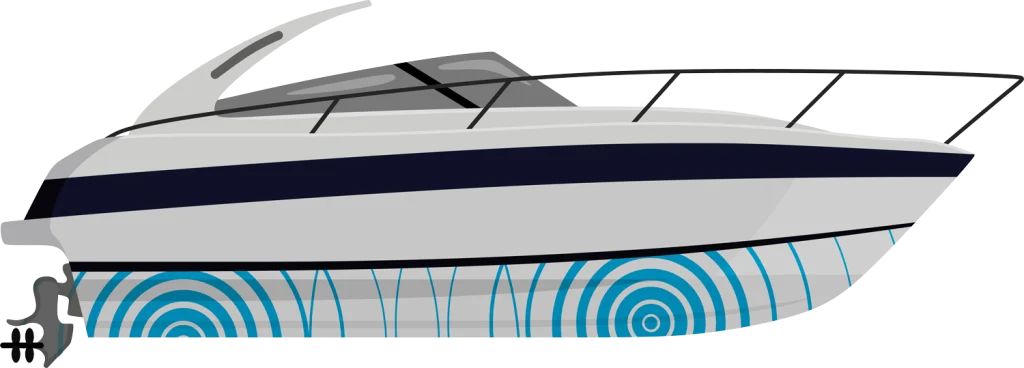
HullSonic stops fouling at the first stage. Transducers bonded to the inside of the hull send ultrasound through it, and each one protects a zone roughly 4.5 to 5 metres across.
At the wet surface the ultrasound keeps the water against the hull constantly disturbed. The film of slime struggles to form, so weed and barnacles have little to build on.
- It runs around the clock, including the weeks the boat sits still, when barnacles settle fastest.
- Nothing goes through the hull and nothing is released into the water.
- Keep your antifouling paint: with less growth to hold off, it can last two to three times as long.
- Propellers, shafts and rudders get some protection too, less than the hull. The layout planner shows what fits your boat.
Owners
What owners find at haul-out
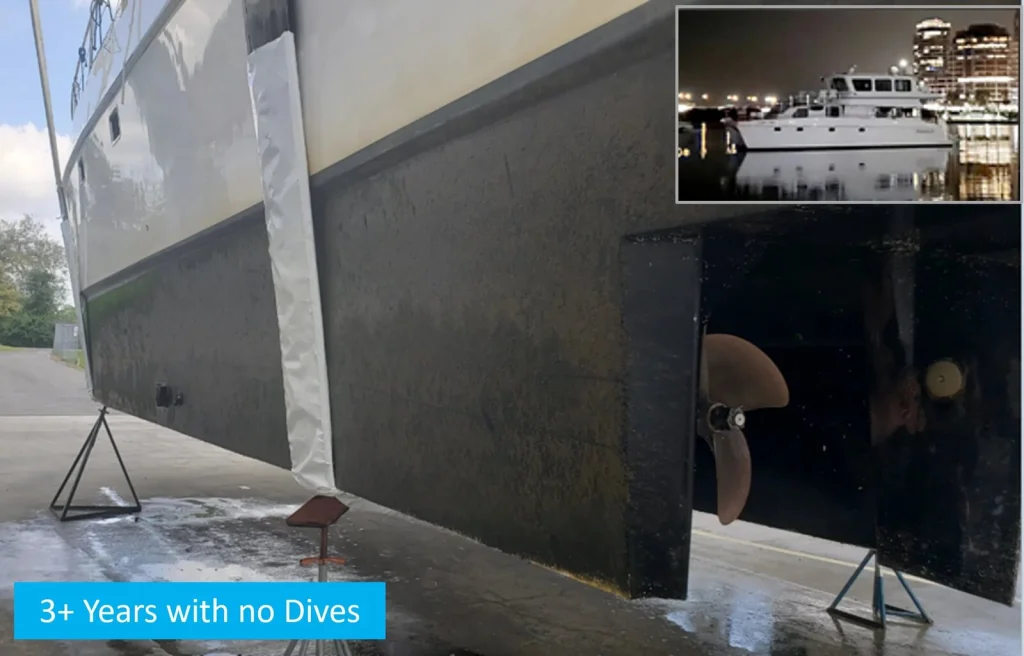
“The hull, with the exception of some slime, was in perfect condition with just a few small barnacles here and there. It has never been cleaned since the last bottom paint job in January 2019.” Captain Steve R., Endeavour 50 power catamaran, Caribbean
“No grass, no barnacles, and only a thin coating of slime, which easily wipes off.” Don P., Nordhavn 55, five weeks after fitting
More owner results, with the boat, the water and how long.
See the layout for your boat
Pick your boat, drive and what you want protected. The layout planner draws the transducer positions on your hull and shows the HS or MAX system that fits.