
How it works
Sound, not chemistry
Ultrasonic antifouling stops marine growth getting a hold on your hull. Here is what it does, what it doesn’t, and what makes the difference to results.
The problem
Why hulls foul
Fouling starts with a microscopic film of bacteria and algae. Larger organisms (weed, barnacles, tubeworm) settle on that film. A fouled hull is slower, burns more fuel, and needs more haul-outs and diver cleans. Antifouling paint slows it down, but paint wears, and boats that sit still foul fastest.
- A thin film Bacteria and algae coat the hull.
- Weed It takes hold on the film.
- Barnacles They settle on that, and stay.
The idea
Stop it at the first stage
If the film cannot form, weed and barnacles have nothing to build on. That is all HullSonic sets out to do, and it does it with sound: nothing is added to the water.
- The control module powers each transducer and keeps it tuned to the part of the hull it sits on.
- Each transducer is bonded to the inside of the hull. Nothing goes through the hull and nothing sits in the water.
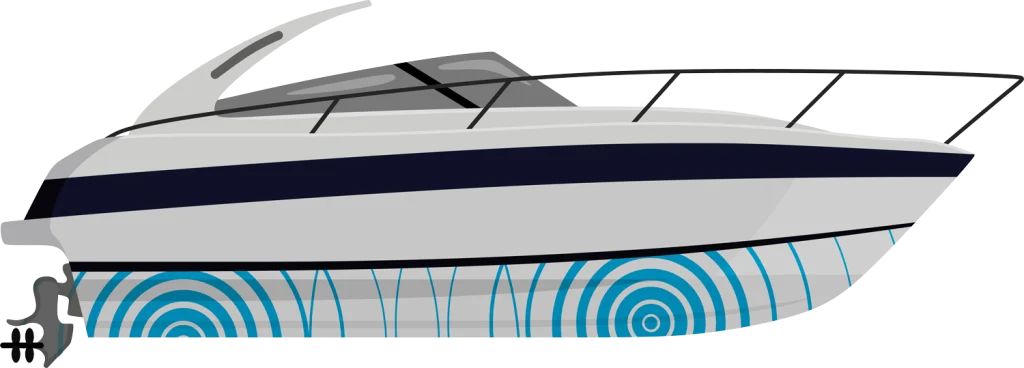
- Ultrasound spreads through the hull around the transducer, protecting a zone roughly 4.5–5 metres across.
- At the wet surface it keeps the water against the hull constantly disturbed. The first film of growth struggles to form, so weed and barnacles have little to build on.
In a little more detail: the transducers drive ultrasonic energy into the hull and the water against it. In the water, the pressure cycles thousands of times a second; tiny bubbles form and collapse (cavitation) right at the surface. That constant disturbance is what keeps the early film from forming.
The technology
Four channels, each tuned and checked on its own
The control module does more than switch transducers on. It runs four channels as four separate systems: each one is tuned to the hull under its transducer when you power up, retuned as it runs, and watched for faults the whole time.
- One control module drives four channels, and treats each as a system of its own.
- Each channel sweeps 19–80 kHz and tunes itself to the hull under its transducer, because thickness, material and shape differ from one spot to the next. It keeps retuning while it runs.
- Each channel is checked for a cable that is disconnected, a short circuit and a transducer that has come away from the hull.
- The display shows the state of every channel, and a fault lights the warning lamp, so you know which transducer to look at.
On the display, each channel reports its own state: high or low power, disconnected, short circuit, or detached from the hull. If the battery runs low, the module stops output to protect it.
Coverage
Zones that overlap
Each transducer protects a zone roughly 4.5–5 metres across. A good layout overlaps those zones along the hull and puts a transducer as close as it can to the running gear (propellers, shafts, legs and rudders), because those foul fast and cost the most to clean. Running gear is harder to protect than hull plating, and what is possible depends on how the boat is built.
From box to boat
Three steps to a protected hull
Plan the layout
The planner works out how many transducers your boat needs and where they go.
Bond inside the hull
Transducers sit on the dry side of the hull. Nothing goes through it and nothing hangs in the water.
Let it run
The controller drives every channel continuously, retuning each one to its hull section.
Straight answers
Does ultrasonic antifouling work?
It works as prevention, and results depend on conditions. Owners report clean hulls between haul-outs in tropical and temperate water, and the most common gap we see is a layout with too few transducers for the boat. Independent tests over the years have shown mixed results across brands, which is why we are specific about what affects them.
First
Start clean
Ultrasonic prevents new growth; it does not remove growth that is already there. Fit on a clean hull, ideally after a fresh antifouling.
Layout
Use enough transducers
Too few leave gaps between their zones.
Power
Keep it running
Protection needs the system on continuously; ECO mode is there for limited power.
Conditions
Water and use matter
Warm, nutrient-rich water and long periods at anchor are the hardest conditions.
We would rather you know this before you buy than after. If you want a second opinion on your boat, ask a local installer.
Safety
Safe for your boat and the water
Your boat
No electrolysis
Transducers are galvanically isolated and driven with alternating current.
The water
Nothing released
No biocides or metals in the water from the system itself.
Approvals
Certified
To FCC, CE and RCM requirements, as a complete system.
Hull materials
GRP, aluminium and steel
Not suitable for timber or ferro-cement hulls. Foam- or balsa-cored hulls need a small modification at each transducer site.
Not sure how many transducers?
Pick your boat, drive and what you want protected. The layout planner draws the transducer positions on your hull and puts the matching HS or MAX system in your cart.