Amounts in this article are in US dollars. They are worked examples, not quotes. Work out your own figures with the savings calculator.
You glance at your fuel gauge after a day on the water and wince. Wasn’t it fuller last time? Your cruising speed seems slower, too—did the engine lose power, or is something else going on?
The culprit is likely growing silently beneath your waterline: marine biofouling. And it’s costing you far more than you realize.
Most boat owners understand that barnacles, algae, and slime are bad for their hulls. But when pressed for specifics, they typically cite two costs: haul-outs and bottom paint. These visible expenses are just the tip of the iceberg.
Let’s pull back the curtain on the true financial impact of marine fouling—including the hidden costs that drain your wallet every time you leave the dock.
The Obvious Costs (That Everyone Knows About)
Bottom Paint and Reapplication
The most visible expense is antifouling paint itself. For a typical 35-foot vessel:
- Quality bottom paint: US$300-500 per application
- Professional application labor: US$800-1,200
- DIY supplies (if doing it yourself): US$100-200 for rollers, brushes, solvents, protective equipment
Frequency: Every 1-2 years in most climates; annually in tropical or high-fouling waters.
Annual cost estimate: US$650-850 (averaging replacement costs)
Haul-Outs and Hull Maintenance
Getting your boat out of the water isn’t cheap:
- Haul-out and launch: US$400-800 (varies widely by region and vessel size)
- Pressure washing: US$200-400
- Hull inspection and prep work: US$300-600
- Blocking and storage fees: US$150-300 for the few days required
Frequency: Every 1-2 years, or annually in aggressive fouling environments.
Annual cost estimate: US$525-1,050 (averaging replacement costs)
Underwater Hull Cleaning
Many boat owners hire divers for mid-season cleanings between haul-outs:
- Professional diver cleaning: US$3-8 per foot of boat length
- For a 35-foot boat: US$105-280 per cleaning
- Typical frequency: Every 2-3 months in warm waters, 2-3 times per season in temperate climates
Annual cost estimate: US$400-1,100 depending on location and usage
Obvious Cost Subtotal: US$1,575-3,000 per year
That’s already significant—but we’re just getting started.
The Hidden Costs (That Silently Drain Your Wallet)
Increased Fuel Consumption: The Silent Budget Killer
Here’s where marine fouling really hits your wallet: drag.
Even a light coating of slime—invisible to the eye—can increase hull resistance by 10-15%. As fouling progresses to visible algae, soft growth, and eventually hard barnacles, drag increases exponentially.
The fuel consumption impact:
- Light fouling (slime film): 10-15% increase in fuel consumption
- Moderate fouling (visible algae and soft growth): 20-30% increase
- Heavy fouling (barnacles and hard growth): 40-60% increase
Let’s calculate what this means in real dollars for a typical 35-foot powerboat:
Baseline fuel consumption:
- Average cruising: 8 gallons per hour
- 100 hours of use per season (weekend cruising)
- Fuel price: US$4.50 per gallon
- Clean hull annual fuel cost: US$3,600
With moderate fouling (25% increase):
- 10 gallons per hour instead of 8
- Same 100 hours of use
- Fouled hull annual fuel cost: US$4,500
- Additional cost from fouling: US$900 per year
With heavy fouling (50% increase):
- 12 gallons per hour instead of 8
- Same 100 hours of use
- Heavily fouled hull annual fuel cost: US$5,400
- Additional cost from fouling: US$1,800 per year
And that’s being conservative. Studies show that heavily fouled commercial vessels can see fuel consumption increases of 80% or more.
Hidden cost: US$900-1,800 per year in excess fuel
Reduced Top Speed and Lost Time
Fouling doesn’t just cost you money—it costs you time. That favorite anchorage that’s normally a 2-hour cruise? With a fouled hull, you’re looking at 2.5 or even 3 hours.
The efficiency loss compounds:
- Longer trips burn more fuel (already calculated above)
- Reduced speed limits your cruising range
- Less time at your destination, more time in transit
- Potential missed weather windows on longer passages
While harder to quantify in dollars, lost time is still a cost—especially when your boating season is limited.
Accelerated Engine Wear
Your engine doesn’t operate in a vacuum. When your hull is fouled:
- The engine works harder to achieve the same speeds
- Operating temperatures run hotter
- RPMs are higher for equivalent performance
- More frequent oil changes may be needed
- Components wear faster under sustained high-load conditions
Conservative estimate: Fouling may reduce engine life by 10-15%, translating to earlier rebuilds or replacement.
For a diesel engine that might last 5,000 hours under normal conditions:
- Reduced lifespan: 4,250-4,500 hours
- Engine rebuild or replacement: US$15,000-30,000
- Additional cost per season (100 hours/year): US$300-700 in accelerated depreciation
Hidden cost: US$300-700 per year in accelerated engine wear
Running Gear Damage and Replacement
Fouling doesn’t just affect your hull—it attacks everything below the waterline:
Propellers:
- Barnacles on prop blades cause imbalance and vibration
- Pitting and erosion from biological activity
- Reduced efficiency even after cleaning (surface damage)
- Replacement/professional reconditioning: US$800-2,500
Shafts and bearings:
- Fouling creates irregular loads and vibration
- Accelerated wear on shaft seals and cutlass bearings
- Increased maintenance frequency
- Premature replacement costs: US$400-1,200
Through-hulls and intakes:
- Blocked cooling water intakes
- Restricted flow to engines and generators
- Risk of overheating and catastrophic damage
- Emergency repairs and downtime: US$500-3,000+
Anodes:
- Fouling can interfere with proper anode function
- Accelerated corrosion on through-hulls and running gear
- Additional anode replacement costs: US$100-300 annually
Conservative estimate of accelerated running gear replacement costs: US$400-800 per year
Lost Resale Value
When it’s time to sell, surveyors and potential buyers scrutinize your hull and running gear. Evidence of neglected fouling shows up as:
- Pitting and erosion on the hull
- Damaged gel coat
- Worn running gear
- Hull blisters (osmotic blistering accelerated by poor antifouling maintenance)
A boat with a history of fouling issues or visible damage from inadequate protection can lose 5-10% of its resale value compared to a well-maintained comparable vessel.
For a US$150,000 boat: US$7,500-15,000 reduced resale value
Amortized over 10 years of ownership: US$750-1,500 per year
Environmental Compliance Costs
As regulations tighten worldwide:
- Restricted paint formulations may be less effective, requiring more frequent application
- Some jurisdictions require special disposal for painted hull waste
- Marina fees increasingly include environmental compliance charges
- Future regulation changes may require complete paint removal and reapplication
Estimated compliance and disposal costs: US$100-300 per year
The “Hassle Tax”
There’s a cost that doesn’t appear on any invoice: the time and frustration of dealing with fouling.
- Coordinating haul-outs and yard schedules
- Days or weeks without your boat during maintenance
- Physical labor (if DIY) or project management (if hiring professionals)
- Lost weekends that could have been spent on the water
What’s your time worth? Even at a modest value, the hassle of fouling management adds up quickly.
The Total Cost of Marine Fouling
Let’s add it all up for a typical 35-foot powerboat with moderate fouling:
| Cost Category | Annual Cost |
|---|---|
| Bottom paint & reapplication | US$650-850 |
| Haul-outs and maintenance | US$525-1,050 |
| Underwater cleaning (seasonal) | US$400-1,100 |
| Subtotal: Obvious Costs | US$1,575-3,000 |
| Excess fuel consumption | US$900-1,800 |
| Accelerated engine wear | US$300-700 |
| Running gear replacement | US$400-800 |
| Reduced resale value | US$750-1,500 |
| Environmental compliance | US$100-300 |
| Subtotal: Hidden Costs | US$2,450-5,100 |
| TOTAL ANNUAL COST | US$4,025-8,100 |
Over 10 years of ownership: US$40,000-81,000
And remember—these are conservative estimates for moderate fouling on a mid-sized vessel. Larger boats, vessels in high-fouling environments, or boats with heavier growth will see significantly higher costs.
The Real Question: What’s Your Actual Cost?
Your specific fouling costs depend on several factors:
Vessel size: Larger boats = more surface area = higher costs across all categories
Usage patterns:
- Boats that sit idle foul faster than those used regularly
- Underway motion provides some mechanical cleaning
- Stagnant water increases fouling rate
Location:
- Tropical waters: Higher fouling pressure year-round
- Temperate waters: Seasonal fouling patterns
- Freshwater: Different organisms, but still significant fouling
Water conditions:
- Marina vs. mooring vs. dock
- Water circulation and nutrient levels
- Pollution and runoff impact
Current protection methods:
- Paint quality and application
- Maintenance frequency
- Use of additional protection systems
Breaking the Cycle: What Better Protection Changes
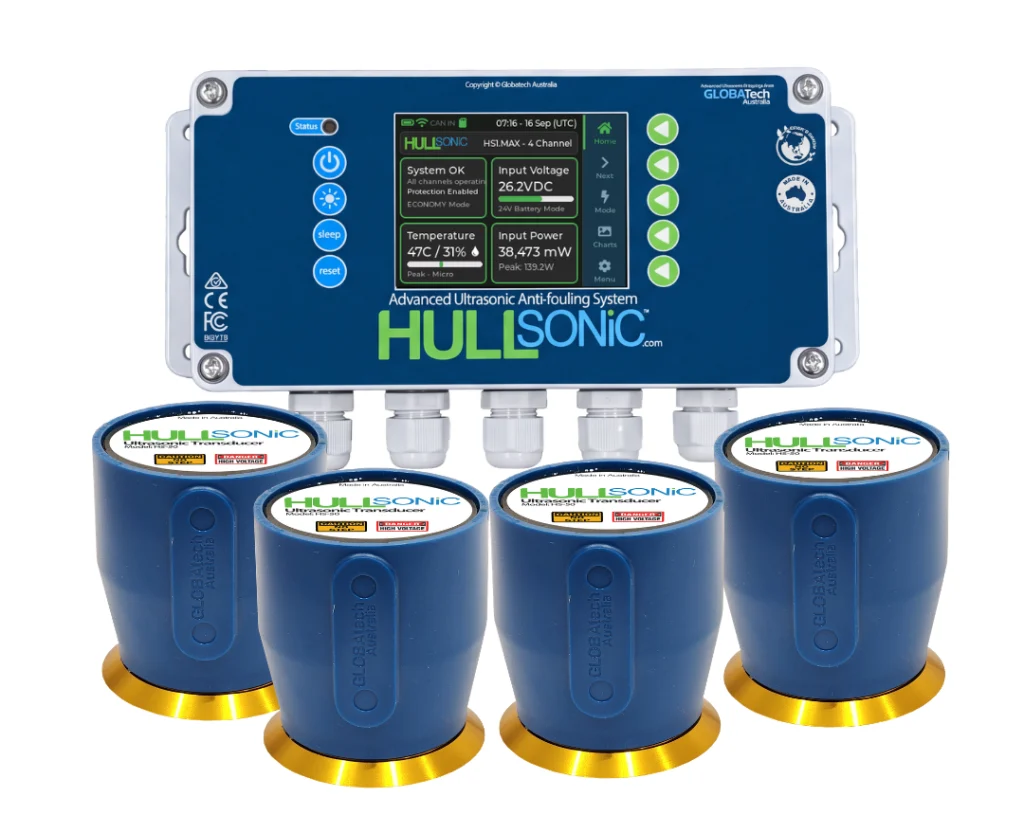
Ultrasonic antifouling does not replace bottom paint. It works alongside it, all the time, to stop growth getting a hold between haul-outs. On many boats that means the coating can last two to three times as long and fewer diver cleans are needed. How much it changes depends on the boat, the water it sits in and how it is used.
That is why we do not quote a payback period here. Your own figures give a better answer than an average:
- The savings calculator starts from what you spend now on haul-outs, antifouling and diver cleans, and shows a range. It leaves fuel out, because the fuel a cleaner hull saves varies too much to promise.
- The systems page shows today’s prices in your currency. Fitting by an installer is extra; many owners fit the system themselves.
- The layout planner shows how many transducers your boat needs, which decides the system.
Take Control of Your Costs
Marine fouling is not inevitable, and neither is everything it costs. Start with your own numbers, then decide what is worth changing.
Ready to see your figures? Work out what you could save.
FAQ: Understanding Your Fouling Costs
Q: How much fuel am I really wasting from fouling?
A: Even light fouling (barely visible slime) increases fuel consumption by 10-15%. Moderate fouling (visible algae) costs 20-30% more fuel. Heavy fouling (barnacles) can increase consumption by 40-60% or more. For a typical powerboat burning 8 gallons per hour, this translates to US$900-1,800 extra per season in fuel costs alone.
Q: Can I just dive my hull more frequently instead?
A: Frequent cleaning helps but has limitations. Each dive costs US$100-280, and you’d need 4-6 per season to maintain effectiveness—totaling US$400-1,700 annually. Plus, repeated scrubbing damages bottom paint, actually requiring MORE frequent haul-outs and repainting. You’re still spending thousands per year and dealing with constant scheduling. An ultrasonic system works between cleans to stop growth getting a hold, so many boats need fewer of them.
Q: Is fouling really affecting my engine?
A: Absolutely. Sustained high-load operation (what happens when pushing through water with a fouled hull) increases wear on all engine components. Oil breaks down faster, temperatures run higher, and component lifespan decreases. While hard to quantify exactly, marine engine specialists estimate fouling can reduce engine life by 10-15%.
Q: What if I’m only in the water a few months per year?
A: Seasonal boats face unique challenges. Fouling accelerates rapidly in warm months, and sitting idle increases growth rates. You’ll likely need a haul-out at season’s end for cleaning and repainting, then another cleaning at season’s start. Plus, fouling doesn’t stop just because you’re not using the boat—it continues 24/7 while you’re on the hard or in winter storage.
Q: How do I know if my costs are higher than average?
A: Track your actual expenses for one season: all bottom paint, haul-outs, cleaning, and fuel consumption. Compare your fuel usage early season (clean hull) vs. late season (fouled hull) at the same speeds and conditions. Most boat owners are shocked when they actually calculate their total fouling costs.
HullSonic ultrasonic antifouling systems provide continuous, automatic protection against marine growth without chemicals, recurring costs, or constant maintenance. Learn more about how HullSonic can reduce your costs and improve your time on the water at hullsonic.com.